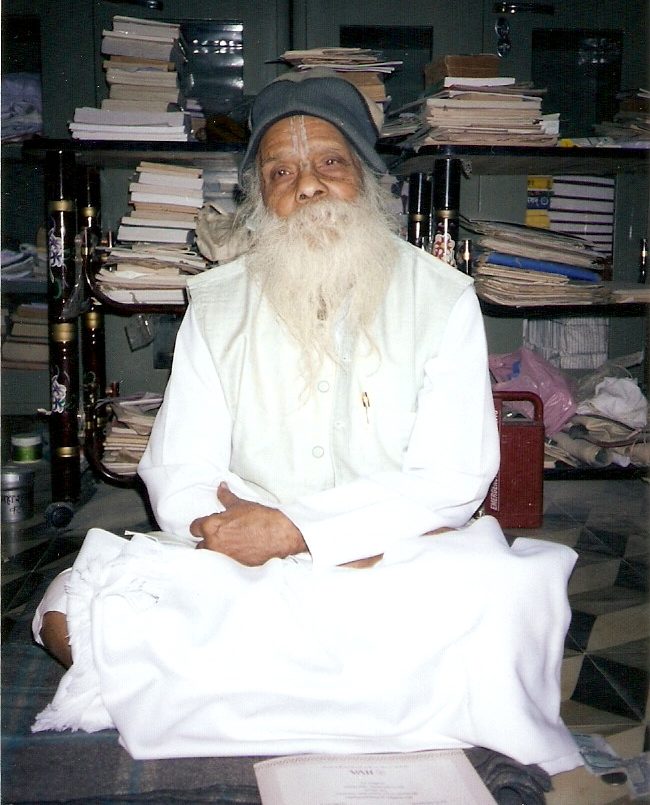
Śrī Haridāsa Shastri Maharaj ji (1918-2013) was as an eminent Indian Gaudiya Vaisnava scholar and practitioner, who is acknowledged for his prolific contributions by the scholarly community of Vṛndāvan. A master of Sanskrit, he authored over sixty books, encompassing translations of various Gauḍīya texts, accompanied by his insightful commentaries. Among his notable works are the esteemed Vedānta-darśanam bhāgavata bhāṣyopetam, comprehensive translation-cum-commentaries of the Sat Sandarbhas, and transliterations of Śrī-caitanya-bhāgavata, Śrī-caitanya-caritāmṛta, and Śrī-caitanya-maṅgala. Jonathan Edelmann from the University of Florida hailed Śāstrī as “arguably the most prolific and well-educated Gauḍīya Vaiṣṇava ‘insider’ scholar of the twentieth century,” noting his distinct scholarly voice as distinct from other more renowned institutions like Gaudīya-Maṭha and ISKCON. Dr. Satyanarayana Dasa, a distinguished Gauḍīya scholar and practitioner, stands among his disciples.
Early Life and Spiritual Initiation
Born in 1918 in Ropa, West Bengal, to Śrīmatī Suśīlā Devī and Śrī Abhayacaraṇa Cattopādhyāya, Maharaj ji( was known as Phaṇīndra Nāth during his childhood. In 1933, at the age of 15, he embarked on a journey to Mathura, finding guidance under the care of Pandita Bābā Śrī Rāma Kṛṣṇadāsaji.
Pandita Bābā selected Śrī Vinod Vihārī Goswāmī, his only veṣa disciple, as the teacher for Phaṇīndra Nāth. Under Śrī Vinod Vihārī Goswāmī’s tutelage, Phaṇīndra received mantra dīkṣā, adopting the name Haridāsa. After a year, he received bābājī-veṣa dīkṣā from his guru, living with him in devoted service. In addition to studying under his guru, Maharaj ji( delved into the teachings of other eminent Vṛndāvan scholars, including Pandita Amolakrama Śāstrī and Dhananjaya Dāsa.
Directed by his guru, Śrī Haridāsa later pursued a twelve-year study of Indian philosophy in Benares. He earned nine graduate degrees and three post-graduate degrees, covering the breadth of the six systems of Indian philosophy and theology. His academic journey included mentorship under distinguished scholars like Vāmacharan Śāstrī and Harerāma Śāstrī.
Vedāntadarśanam
Addressing a critical gap in Gauḍīyā Vaiṣṇava literature, Śrī Haridāsa Śāstrī’s Vedānta-darśanam explored the relationship between individual verses of the Śrīmad Bhāgavatam and the Vedanta-sūtras. The Śrīmad Bhāgavatam presents itself as a commentary on the Vedanta-sūtras by the same author, sage Vyāsa, but until Maharaj-ji, no one had established the verse by verse connection between the two texts with precision. Recognized for its exceptional scholarship, the work received an award from the Nāgarī Pracāriṇī Sabhā of Benares.
The type of service attitude inherent in the practical pursuit of dharma becomes possible
Establishment of Śrī Haridāsa Niwāsa āśrama
In 1965, Śrī Haridāsa founded the Śrī Haridāsa Niwāsa āśrama in Kālīya-daha, Vṛndāvana. At the heart of this āśrama, he established the first temple in Vṛndāvana featuring deities of Śrī Caitanya Mahāprabhu and Śrī Gadādhara Paṇḍita.
Paramparā and Gadādhara-Gaura Hari Press
Being part of the Gadādhara parivāra, Śrī Haridāsa Śāstrī belonged to a lineage of guru-śiṣya originating from Śrī Gadādhara Paṇḍita. The Gadādhara-Gaura Hari Press, which he established, aimed to make the works of Gaudiya Vaisnava acharyas, particularly those of Jiva Goswami, accessible to the public. His translations and publications, numbering around 60 books in Sanskrit and Hindi, included his own insightful commentaries. Notably, he was the first to translate and comment on Jīva Goswāmī’s Sat Sandarbhas into Hindi. The Śrī Gaura-Gadādhara Granthāgāram library, associated with the press, has become one of the largest libraries in Vṛndāvan.
Devotion to Cows and Śrī Haridāsa Śāstrī Cow Institute
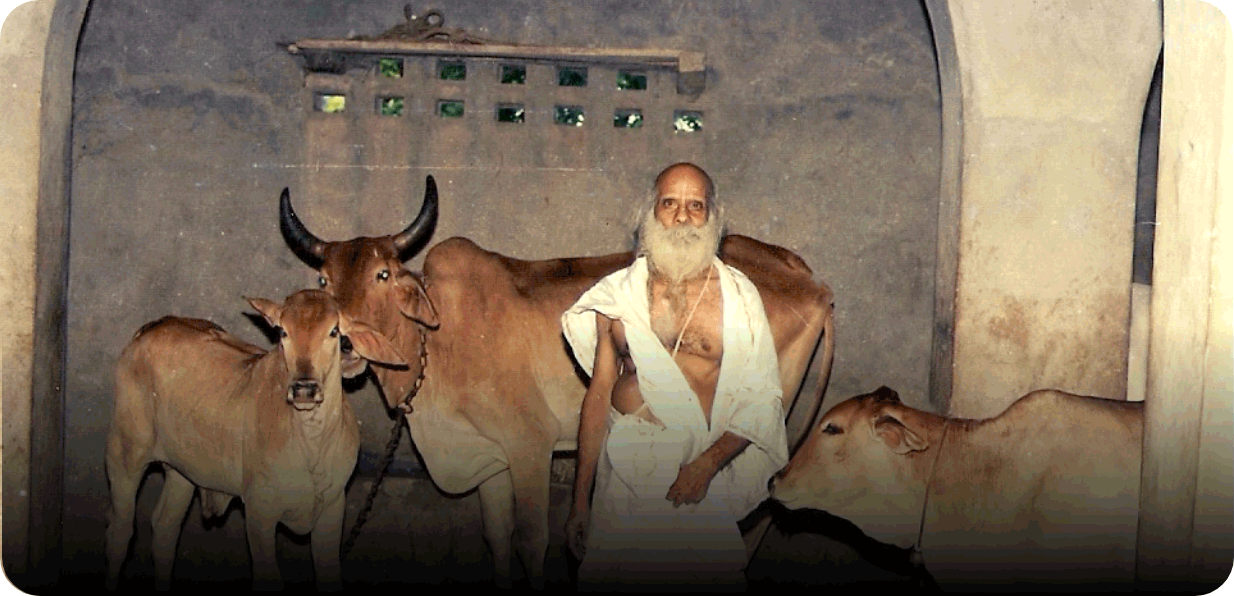
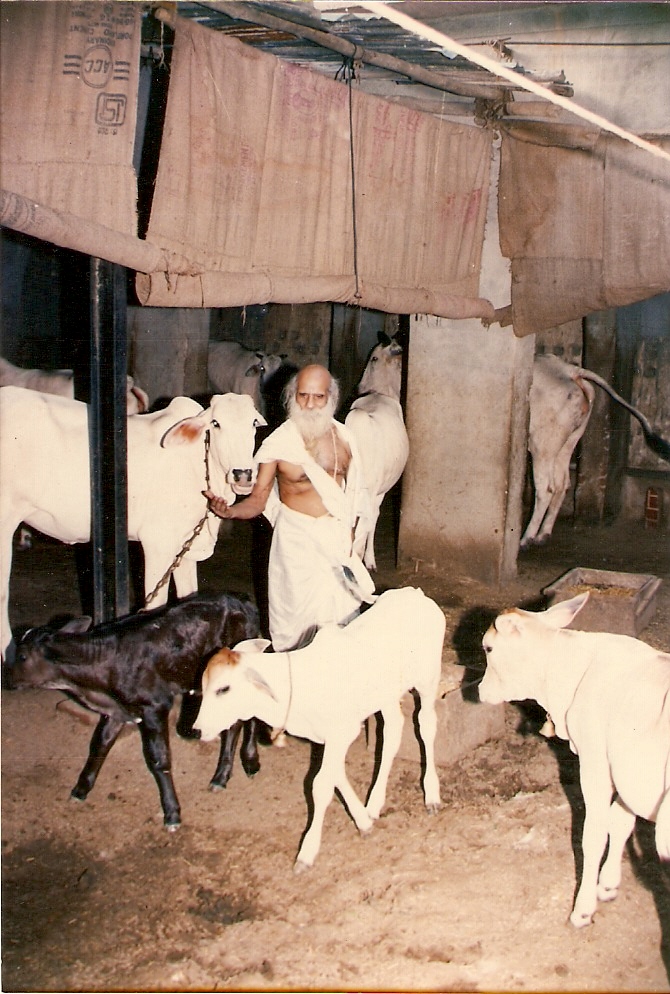
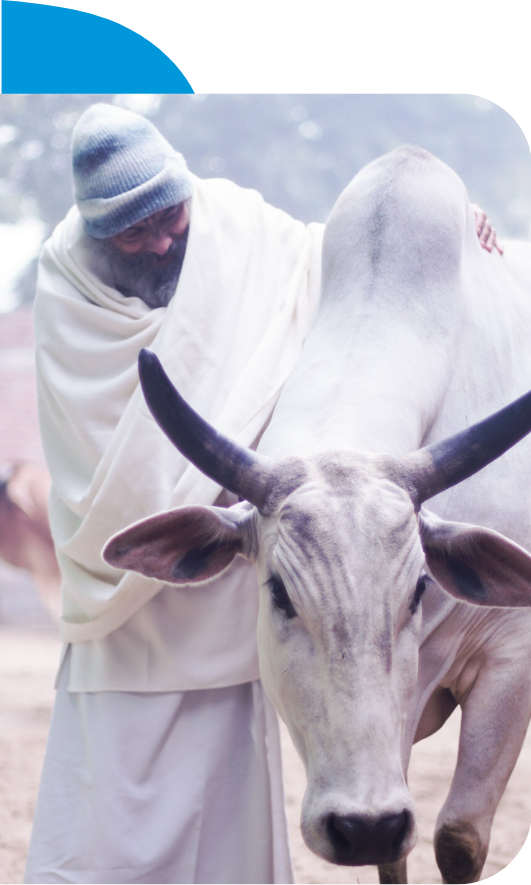
Śrī Haridāsa Śāstrī’s love for cows was manifested through his care for each cow in his ashrama’s cowshed. Initiating the cowshed in 1981 with only two cows and a bull, it grew to accommodate 250 cows and bulls by the time of his passing, and has continued growing ever since under the auspices of his disciples. To ensure the continuity of the services he initiated, he established the Śrī Haridāsa Śāstrī Cow Institute, governed by a board of trustees.
गावो लक्ष्म्या: सदा मूलंगावो लक्ष्म्या: सदा मूलंगावो लक्ष्म्या: सदा मूलंगावो लक्ष्म्या: सदा मूलंगावो लक्ष्म्या: सदा मूलंगावो लक्ष्म्या: सदा मूलं
Books
Śrī Haridāsa Śāstrī’s extensive bibliography spans diverse subjects, including philosophy, theology, poetry, and scriptural exegesis. His works such as Śrī-Rādhā-Kṛṣṇārcana-dīpikā, Dharma-saṁgraha, and Śrī-caitanya-sūkti-sudhākara reflect his holistic approach to knowledge. The list of the titles he authored include: